
What is a Clean Air Zone?
A Clean Air Zone is a specific area where the most polluting vehicles are discouraged from entering. These zones are part of a longer-term plan to reduce the number of places in the UK where air pollution breaches legal limits.
No vehicle is banned from a CAZ but vehicles that aren’t clean enough may have to pay a daily charge if they wish to travel within the area. There are different grades of CAZ depending on how tough the local authority believes it needs to be to tackle pollution.
Vehicles driving in the zones will be identified using automatic number plate recognition (ANPR) cameras. The area and vehicle will evaluate the clean air zone charges you receive.
What are the different zone classes?
The four different classes of Clean Air Zones are A, B, C and D. These indicate which vehicles have restrictions imposed and increase from the lighter touch A to D which includes all classes of vehicle.
ClassVehicle typesCAZ ABuses, coaches, taxis, private hire vehiclesCAZ BBuses, coaches, taxis, private hire vehicles, heavy goods vehiclesCAZ CBuses, coaches, taxis, private hire vehicles, heavy goods vehicles, vans, minibusesCAZ DBuses, coaches, taxis, private hire vehicles, heavy goods vehicles, vans, minibuses, cars and the local authority (may include motorcycles)Despite fewer vehicle categories targeted for charging, CAZ class A areas will still use key signage and actively encourage those driving cleaner, ultra-low emission vehicles (ULEV).
Air quality targets are expected to be met by local authorities updating their own vehicles and by ensuring bus, taxi and private hire vehicle emissions standards are improved.
Preferential treatment - from parking to EV charging points - will be given to those driving ULEVs. Healthy, active travel modes will also be promoted.
At the other end of the scale, CAZ D penalises almost everyone driving more polluting vehicles, especially older models.
In some cities, CAZs won’t go far enough and Low Emission Zones (LEZ), Ultra Low Emission Zones (ULEZ) or Zero Emission Zones will ban non-compliant vehicles.
London, for example, replaced the T-charge in 2019 with a ULEZ which operates round the clock. By October 2021, the ULEZ will be extended to an area 18-times larger than the original zone, encompassing London boroughs up to both the North and South Circular roads.
What are the emission standards for each vehicle class?
To avoid being charged in a Clean Air Zone, your vehicle must meet the following minimum standard:
Vehicle typeMinimum emissions standardBuses, coaches, heavy goods vehiclesEuro VIVans, minibuses, taxis, private hire vehicles, carsEuro 6 (diesel) and Euro 4 (petrol)MotorcyclesEuro 3Where are the zones?
The following either have or are planning CAZs and we can expect others to follow:
Bath, Bristol, Greater Manchester, Liverpool, Newcastle, Gateshead, North Tyneside, Portsmouth, Sheffield, Birmingham, Bradford, Leicester, London, Oxford, Aberdeen, Dundee, Edinburgh and Glasgow.
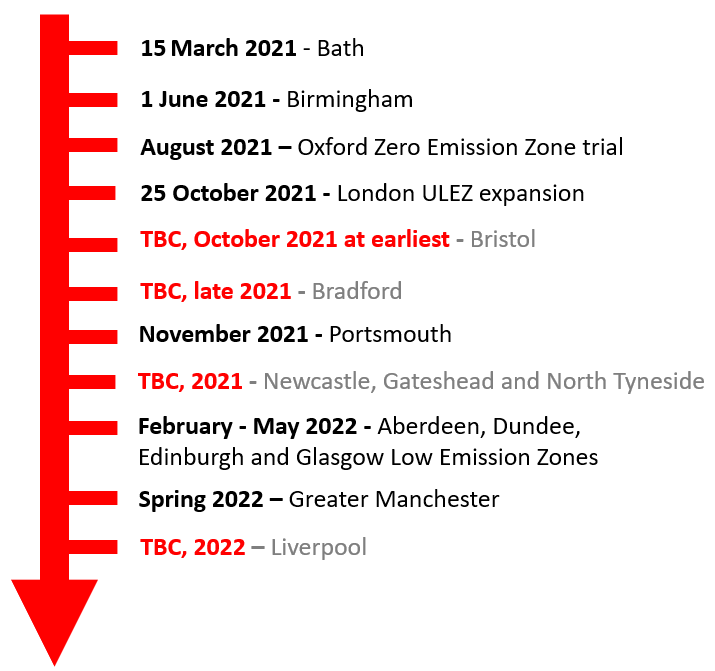
Image credit: BVLR.co.uk
How do I know if I have to pay?
With the different zone classes and timelines, it is hard to keep track of what each city is doing. You’ll have to find out the emissions standard of your vehicle(s) too.
The easiest way to check is by using the clean air zone checker on the government website. When you enter your vehicle registration, it lists the CAZs across the UK and whether payment is required.
You can check (and pay) for one or multiple vehicles. And there are maps to show the defined zones.
Transport for the London clean air zone has its own government check page.
For businesses managing two or more vehicles, it is possible to set up an account where:
Multiple vehicles can be uploaded - either individually or via a spreadsheet
You can view what each vehicle will be charged in each CAZ
Vehicles can be added or deleted from the list
Up to 10 colleagues can be added to help manage the account
A bank account can be used to take payment
What if I live in a CAZ?
If you live in a Clean Air Zone and your vehicle doesn’t meet the emissions standards, you will have to pay the daily charge. However, there are some temporary exemption permits for residents. In Birmingham, for example, an exemption is available for up to two years from the launch of the Clean Air Zone.
As you might expect, London is doing things slightly differently and has set aside £25m to support low-income residents to scrap older cars, along with £23m aimed at micro-businesses and charities to scrap vehicles.
London residents were given a limited ‘honeymoon’ period until 24th October 2021 with a 100% discount on the charge. From October - when the ULEZ area extends - they will be forced to pay full price if vehicles do not meet the correct standards.
Exemptions
There are some exemptions from the CAZ charging zones. You won’t have to pay if you have:
A vehicle that has ultra-low emissions
A disabled passenger tax class vehicle
A disabled tax class vehicle
A military vehicle
A historic vehicle
A vehicle retrofitted with technology accredited by the Clean Vehicle Retrofit Accreditation Scheme (CVRAS)
Certain types of agricultural vehicles
It appears the world is quickly moving a step closer towards cleaner living and the Clean Air Zones are a live example of that. The pace of the EV revolution has rapidly grown, but it has been a prospect for automotion for decades. Would you believe us if we said the timeline of the electric car goes back as far as the 1800's?!
Why not join the mission of creating zero emissions by leasing an electric vehicle? We have many options for various makes and models, check out our unbeatable deals for electric and hybrid vehicles today.