
How to start a car with a flat battery
Having a flat battery can be frustrating and stressful, but with this guide from Car Leasing, you'll have all the information you need to safely jump-start your car and get back on the road. Whether you're a seasoned car owner or a first-time driver, this step-by-step guide is easy to follow and covers everything you need to know about jump-starting a car. Read on to learn how to jump-start your car with confidence and peace of mind.
What Is a Flat Car Battery and What Causes It?
A flat car battery is one that no longer holds enough charge to turn the engine over. The battery powers the starter motor and the car's electrics when the engine is off, so when it runs flat, the car will not start.
Common causes include:
Leaving something on: headlights, interior lights or a phone charger left on overnight.
Short trips: lots of short journeys do not give the alternator enough time to recharge the battery.
Not using the car: a battery slowly loses charge when a car is left parked for weeks.
Cold weather: low temperatures reduce how much power a battery can deliver.
Age: most car batteries last around four to five years before they struggle to hold a charge.
A fault: a faulty alternator or an electrical fault that drains the battery.
Signs of a flat battery include a slow or weak crank when you start the car, a clicking sound, dim lights, or the battery or engine management warning light coming on.
Safety Checks Before You Jump Start a Car
Jump starting a car is safe as long as you take a few precautions first:
Check your car's handbook. Many modern cars have jump start points under the bonnet, and some makers have their own instructions.
Do not jump start a battery that is cracked, leaking or swollen, or one that may be frozen.
Make sure both cars use a 12V battery, and that the jump leads are in good condition.
Park the cars close together without touching, turn both engines off and switch off lights and other electrics.
Do not smoke or use a naked flame near the battery, as it can give off flammable gas.
Wear gloves and eye protection if you have them, and remove metal jewellery.
Keep the leads away from the fan, belts and other moving parts, and never let the metal clamps touch each other.
How to Jump Start a Car with a Flat Battery
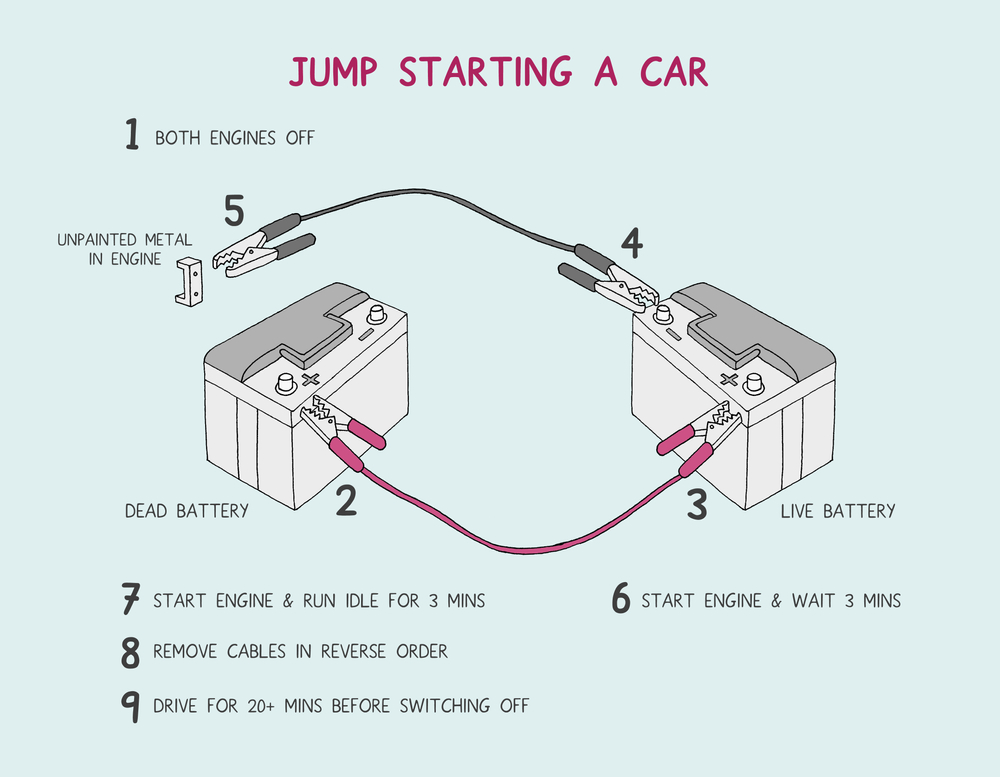
To jump start a car, you need a set of jump leads and a second car with a working battery. Connecting the leads in the wrong order can damage the electrics on either car, so follow these steps in order:
Connect one end of the red lead to the positive (+) terminal on the working battery.
Connect the other end of the red lead to the positive (+) terminal on the flat battery.
Connect one end of the black lead to the negative (-) terminal on the working battery.
Connect the other end of the black lead to an unpainted metal part of the car with the flat battery, away from the battery, or to the earth point shown in the handbook.
Start the car with the working battery and let it run for three to five minutes.
Try to start the car with the flat battery. If it does not start, wait a few more minutes and try again.
Once it starts, leave both engines running and remove the leads in reverse order: black from the earth point, black from the working battery, red from the working battery, then red from the battery that was flat.
Drive for at least 30 minutes, on faster roads if you can, so the alternator can recharge the battery.
If you have to jump start your car often, have the battery tested at a garage. It may need replacing, or something may be draining it. If you lease your car with a maintenance package, check whether a replacement battery is covered before you pay for one yourself.
How to Start a Car with a Jump Starter Pack
A jump starter pack, also called a booster pack, is a portable battery with built-in leads. It lets you start your car without a second car. Always follow the instructions that come with your pack, but the steps are usually:
Make sure the pack is charged and switched off.
Connect the red clamp to the positive (+) terminal on the flat battery.
Connect the black clamp to an unpainted metal part of the car, away from the battery, or to the earth point shown in the handbook.
Switch the pack on and start the car.
Once the engine is running, switch the pack off and remove the black clamp, then the red clamp.
Then drive for at least 30 minutes to recharge the battery, and remember to recharge the pack when you get home.
Can You Jump Start a Car in the Rain?
Yes, you can jump start a car in the rain, as long as you take care. A 12V car battery is unlikely to give you a shock, but water can cause a short circuit or sparks if it gets onto the terminals or clamps. Keep the bonnets open for as short a time as possible, dry the terminals and clamps before connecting them, make sure your hands are dry and do not stand in deep water.
How to bump start your car
If there is no second car or jump starter pack, you may be able to bump start, or push start, a manual car. This works best with two people, or on a gentle downhill slope away from traffic.
Important: never bump start an automatic, hybrid or electric car. Many modern cars with keyless start, stop-start or an electronic handbrake are not suitable either, so check your handbook first.
Turn the ignition on, put the car in second gear and hold the clutch down.
Release the handbrake and let the car roll, or have someone push from behind.
When the car reaches a brisk walking or jogging pace, release the clutch quickly.
The engine should turn over and start. Press the clutch back down straight away and keep the engine running.
Drive for at least 30 minutes to recharge the battery.
Bear in mind that the brakes and steering will feel heavy until the engine starts. Try not to bump start your car often, as it can damage the catalytic converter. If you find you need to, it is time to have the battery checked.
What to Do If Your Car Still Won't Start
If your car still will not start after a jump or bump start, the battery may be too flat or worn out to hold a charge, or the problem may be something else, such as the starter motor or alternator. You have a few options:
Charge the battery fully with a mains battery charger, if you are at home.
Call your breakdown provider. Most can test the battery at the roadside and some can fit a new one.
Have the battery replaced at a garage or by a mobile fitter. Many modern cars need the new battery registered to the car, so check before you fit one yourself.
Can You Jump Start an Electric or Hybrid Car?
Yes, in most cases. Electric and hybrid cars have a 12V battery as well as the large drive battery. The 12V battery powers the locks, lights and computers, and switches the car on. If it goes flat, the car will not start, even if the main battery is fully charged.
Most electric and hybrid cars can be jump started from another car or a jump starter pack using the 12V battery or the jump start points under the bonnet. Check your handbook first, as the steps vary between makes. Do not use an electric or hybrid car to jump start another car unless the handbook says you can, as it can damage its electrics.
If the main drive battery runs out of charge, a jump start will not help. The car will need to be recovered to a charge point, usually on a flatbed truck, as many electric cars should not be towed with their wheels on the ground. Most electric cars warn you well before this happens, and many new ones come with roadside assistance from the manufacturer.
If you are thinking about going electric, take a look at our electric car lease deals. The same applies to most hybrids. Browse our hybrid car lease deals to compare models.
Get your car back up and running
A flat battery is usually easy to fix with jump leads, a jump starter pack or, in a manual car, a push start. To stop it happening again:
Check that lights and accessories are off when you leave the car.
Drive for at least 30 minutes once a week if you mostly do short trips.
Use a trickle charger if the car will be parked for a long time.
Have the battery tested if the car is slow to start, especially before winter.
A healthy battery is one of the checks worth doing before a long trip. Our guide to your first motorway drive covers the others. If your car is getting older and problems like this keep coming back, our new car lease deals come with a manufacturer warranty.
Frequently Asked Questions
Drive for at least 30 minutes after a jump start, on faster roads if you can. This gives the alternator time to recharge the battery. Short, stop-start trips may not put enough charge back in, so the car may not start next time. If the battery is still weak after a long drive, have it tested.
Connect the red lead first. Clip it to the positive terminal on both batteries, then clip the black lead to the negative terminal on the working battery. Connect the last black clamp to bare metal on the car with the flat battery, away from the battery. Remove the leads in the reverse order.
Yes, you can jump start an automatic car in the same way as a manual, using jump leads or a jump starter pack. What you cannot do is bump start, or push start, an automatic. That method only works on manual cars with a conventional engine.
Yes. If a battery is very old, damaged or has been completely flat for a long time, it may not take enough charge from a jump start. Try leaving the working car running for a few more minutes before you try again. If it still will not start, the battery is likely to need charging with a mains charger or replacing.
Not always. If the battery went flat because a light was left on, a good drive should recharge it. If it goes flat again within a few days, or the battery is more than four or five years old, have it tested at a garage, as it may need replacing.